













SLIMBRIDGE DOWSING GROUP REPORTS
Dowsing the Three Perpetual Choirs of Britain - John Gibson-Forty
Sometimes a subject is just too big for an hour’s talk, and certainly too long to do it justice here. That was the problem facing John Gibson-Forty when he came to speak at our meeting on 13th May, but he managed to hold our interest and make us want to buy copies of his book, even though it isn’t published yet.
John is an experienced dowser and has spent three-and-a-half years dowsing the energy lines of a decagon (a ten-pointed, ten-sided figure) that stretches from Stafford in the north to Glastonbury in the south, and from Milton Keynes in the east to Llandovery in the west. It covers 22 counties and an area in excess of 14,000 square miles. And that’s a lot of dowsing.
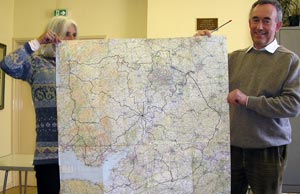 John Gibson-Forty holds up a map showing the
4,000-
John Gibson-Forty holds up a map showing the
4,000-year-old ten-pointed, ten-sided decagon superimposed
over Gloucestershire, Herefordshire and Worcestershire.
Centred on the tiny hamlet of Whiteleaved Oak, exactly where the three counties of Gloucestershire, Herefordshire and Worcestershire meet, the decagon sprouts ten energy lines like the spokes of a wheel, and of course an eleventh line forming the circumference.
Just to make things more interesting, John and his colleague, the late Peter Watson, soon discovered that dowsing these energy lines as they are today was no use, because they have changed, or moved, or suddenly ceased altogether. So they had to dowse them as they were in 2000 BC - that’s 4000 years ago!
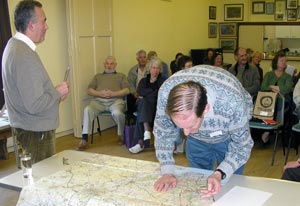 Barry Goldring takes a closer look at the areas contained
within the decagon while John takes questions from
the floor.
Each energy line incorporates various sacred buildings and sites, and naturally John had to dowse and research those too. Associated with King Arthur, the Knights Templar, other religions, and even sacred geometry, each line could fill a book all on its own.
But how did the decagon come to be there and what is its purpose? It is thought to be connected with the three perpetual choirs of Britain, each choir comprising 2,400 druids or monks who chanted on a rolling rota basis, 100 at a time, every hour of the day and night, in order to maintain the ongoing enchantment of Britain.
The first choir was based at Llantwit Major in South Wales, the second at Glastonbury, and the third at Amesbury, near Stonehenge. These three sites are to be found in the lower, western part of the decagon, and the ongoing chanting presumably influenced the whole area.
There is a second decagon, a comparable structure centred where the three counties of Cambridgeshire, Hertfordshire and Essex meet. But that’s another story! It was difficult enough to cover one decagon in the time available, the second one will have to wait.